
What Is the Humanize Dyad?
"A gentle, structured way to reconnect — with yourself, with others, and with our shared humanity."
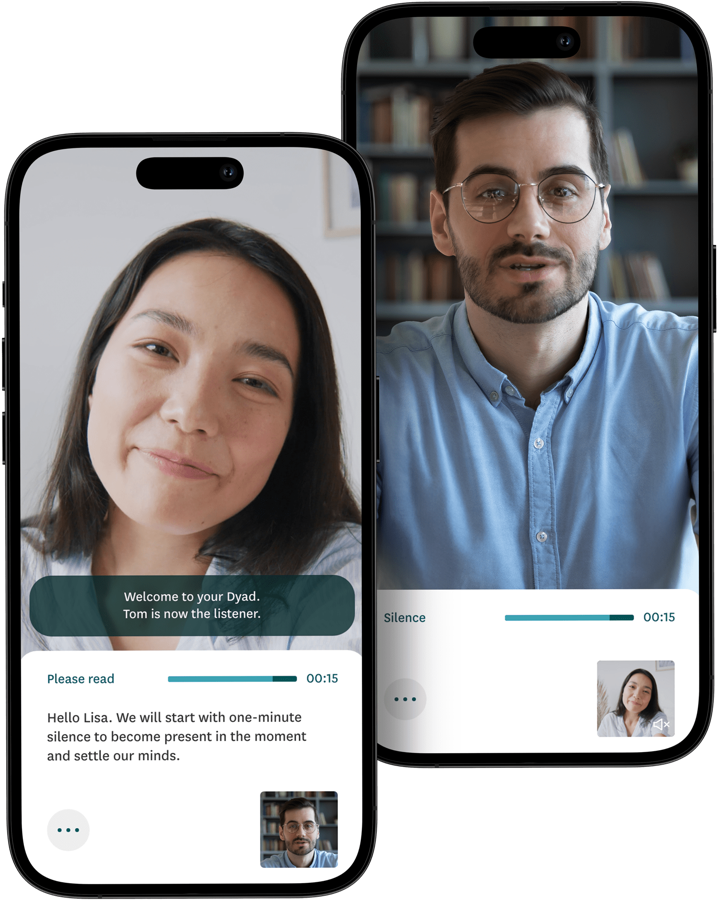
This practice is rooted in social neuroscience and designed as a peer-to-peer dyadic experience. Each day, two people meet online for approximately 15 minutes. They take turns:
Reflect
Reflecting on a difficult emotion they experienced in their body in the past 24 hours
Appreciate
Sharing something they feel grateful for, and noticing how that gratitude is felt in the body
One person speaks while the other listens — fully and without judgment, advice, or interruption.
This is not therapy and not coaching.
It is a structured practice of relational presence and embodied self-reflection.
What Makes This Practice Distinct
The Humanize Dyad is a form of dyadic communication — a brief, structured exchange between two people. As participants alternate between speaking and listening:
Emotional insight deepens
Vulnerability arises without demand
Nervous-system regulation is supported
Trust and presence are strengthened
Over time, individuals notice their own patterns of connection and disconnection while building the capacity to remain present with another human being.
How the Practice Works
Practice is guided online through the platform with 13-minute sessions
Each partner shares one difficult emotion and one moment of gratitude from the past day
Commit to a minimum of 5 sessions per week over 2-week periods
Partners rotate every 2 weeks, allowing you to connect with different people and continue or take breaks as needed
Inside a 13-Minute Session
Two people meet online. One speaks while the other listens — fully and without judgment, advice, or interruption. Then they switch.
Staying connected to bodily sensation while speaking is what lets participants integrate emotion rather than intellectualize it.

Who This Practice Is For — Organizations
Organizations increasingly recognize that performance is shaped not only by strategy and systems, but by the quality of human relationships under pressure.
Breakdowns in communication, trust, and emotional regulation quietly drive:
disengagement and burnout
conflict escalation and avoidance
decision friction and execution delays
customer experience degradation
Who This Practice Is For — Individuals
For individuals, the Humanize Dyad offers a disciplined, grounded way to reconnect:
Participants often experience:
Because the practice is brief and structured, it integrates naturally into daily life without becoming burdensome or performative.
In Summary
The Humanize Dyad is a simple, evidence-informed relational practice that strengthens connection — within individuals, between people, and across organizations.